
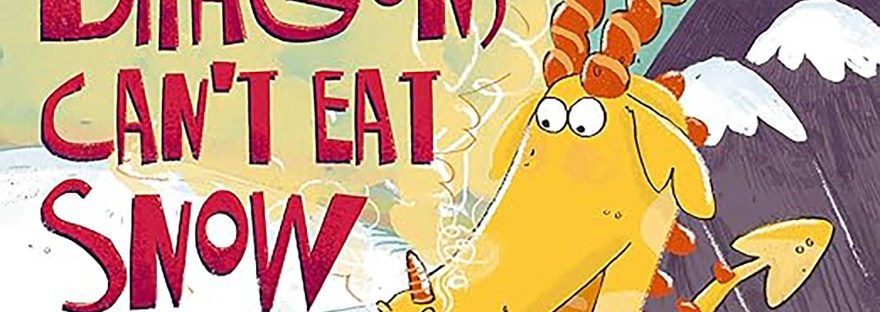

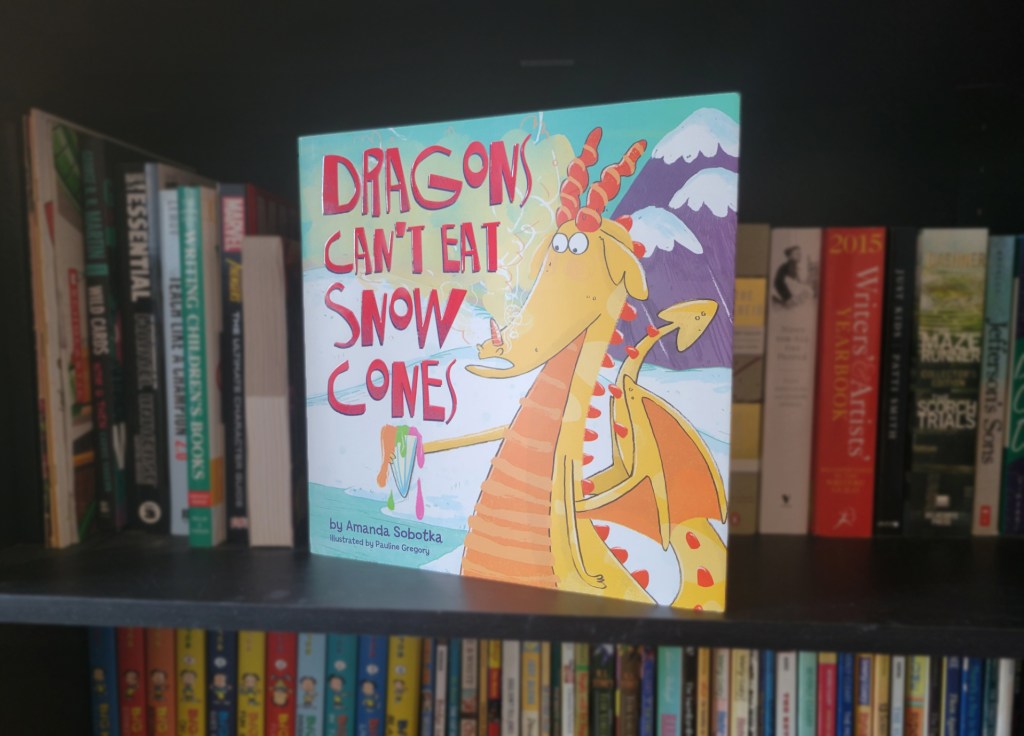
Hello everyone! You may remember when I posted an image of Dragons Can’t Eat Snow Cones, a picture book by Amanda Sobotka, to my Instagram, Threads, Twitter and Bluesky (which I recently joined) earlier this month. In those posts, I announced that I was invited to review an advance reading copy of the book ahead of its release date by Applesauce Press, the children’s imprint of Cider Press, itself an imprint of HarperCollins Focus. And with the book coming out today, I am happy to share my review! Be sure to get it wherever books are sold! Below is the book’s synopsis:
Delicious snow cones and fire-breathing dragons don’t really mix – but don’t tell that to this dragon. With whimsical illustrations and a heart-warming story on the power of not giving up, Dragons Can’t Eat Snow Cones will delight readers of all ages!
Who can blame a dragon for wanting a cool and refreshing snow cone? They come in so many different flavors and colors! Sadly, as soon as the tasty treat is within reach, it melts. This dragon, however, will not give up.
After trying all it can think of to indulge in the slushy confection, the dragon seeks the advice of a colorful variety of friends. However, the chilly penguin, industrious squirrels, parrot pirate, and cave-dwelling bat just can’t seem to help. Still no snow cone.
Will the dragon ever taste a flavorful snow cone that doesn’t turn to slush? Kids of all ages will enjoy this tale of persistence and see tenacity in action in our scaly hero.
I’m glad to have been given this opportunity after my previous review of The Groundworld Heroes! But before we begin, I would like to give a heads up to some spoilers to the book. Let’s get a snow cone as we prepare to look at these pages, shall we?
Background
Earlier this month, I received a message from Rachel Brewer of One Brewer Publicity regarding reviewing Dragons Can’t Eat Snow Cones. Brewer told me that the story is sure to be a bedtime favorite and asked me if I could review an eARC (short for electronic advance reading copy) of the book on NetGalley. Of course, I accepted. Brewer also asked if I wanted a physical copy of the book delivered to me, and I decided to agree, which I posted a picture of on my Instagram, Threads, Twitter and Bluesky ahead of its release, which you can also see below.
In an information sheet Brewer also sent me, it stated that children will discover in the book that challenges can be overcome with some creativity and perseverance. Brewer also informed me that the book is fun and silly, with gorgeous illustrations, but it also highlights qualities like hard work and persistence. It could be just a fun bedtime story, or a launching pad for some good conversations with kids about when they feel like they want to give up on something and how some things are worth working hard at. But how was the book, anyway? Does it truly convey all of these traits?
The Review

The first thing you’ll notice about Dragons Can’t Eat Snow Cones is that the book is written in rhyme – a pretty conventional approach to storytelling in picture books, but Sobotka’s rhyming gets pretty creative at times. There are also quite a few moments when the text gets pink, capitalized, bigger and changes font to emphasize certain words, which was a fairly creative way of playing with the text. If you haven’t figured it out by now, the basic problem is that the book’s titular dragon is incapable of eating a snow cone because dragons have fire breath that immediately melt any ice that comes into contact with their mouths. This of course is a source of frustration and jealousy from the dragon as he watches the other (non-mythical) animals eat their snow cones without incident.

Throughout the book, the dragon appears to have a sidekick that looks like some kind of rodent, though this isn’t mentioned in the text. At first, I thought it was a squirrel, until squirrels appear later in the story, who look very different from the dragon’s sidekick, so then I figured that it was a chinchilla, so that’s what I’ll call it. On the first page, the chinchilla has its ear on fire near the dragon’s melted snow cone, implying a pretty hilarious failure of the dragon’s Plan A, which does a good job at reeling the reader in. Illustrator Pauline Gregory does a great job at implementing these small visual gags throughout the story, from a crocodile holding a “No Littering” sign in a pile of melted snow cones to the chinchilla ending up in an ice cube at the top of a snowy mountain.
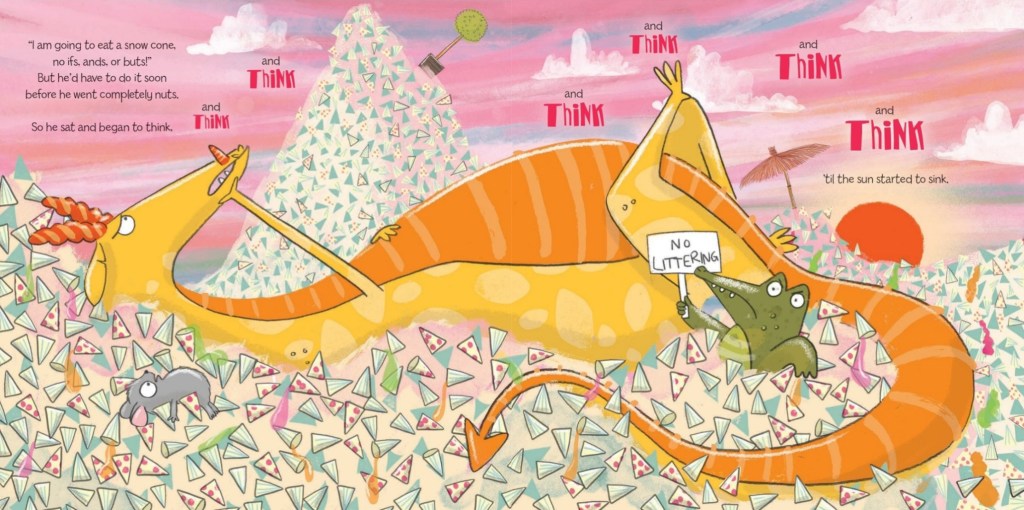

Occasionally, Sobotka will subtly reference a gag in the text, such as implying that a fish ate a snow cone off a fishing rod that the dragon had intended to swing into its mouth. The dragon’s design is pretty quirky which is fitting for the book’s tone and art style, from its big belly to its too-small wings and especially, in my opinion, its overbite (a school of fish on one page certainly seem to agree). Interestingly, humans do in fact appear in the story, which doesn’t happen too often in picture books that predominantly feature animals. There’s a scene in which a fisherman hilariously runs away from the dragon, suggesting that humans in this world are still scared of them.

One of the book’s biggest strengths is the fact that it was hard for me to figure out exactly how the dragon was going to eat its snow cone until the very end. Given the much simpler stories picture books require, it can be difficult to write a plot that’s not too complex but just complex enough that it keeps leaving you guessing. At one point, when the dragon reaches the summit of a snowy mountain, I figured that the weather conditions would be cold enough that the dragon’s fire breath would finally be too weak to melt the snow cone, but as it turned out, that wasn’t what happened.

The dragon’s least effectual plan was definitely a moment when he decides to store a snow cone underground to eat later. It doesn’t exactly help the dragon get the cone in its mouth, and the dragon does not seem to have a problem creating new cones every time they melt or get destroyed. The chinchilla posting a “Missing” sign for that snow cone on a tree was another hilarious gag, though. Ultimately, the dragon’s solution to eating a snow cone ends up being one that the dragon didn’t actually plan. And the result is one that more than pays off for the dragon in a way that was really clever.

Ultimately, Dragons Can’t Eat Snow Cones is a good picture book about how sometimes the best ideas are the ones that happen by accident. The book serving as a launching pad for conversations with kids about feeling like giving up, how some things are worth working hard at, and how challenges can be overcome with some creativity and perseverance are all pretty accurate, which are highlighted by how the dragon stops at nothing to achieve his goal, but only finally succeeds when he gives up. I think that the book can relate to those who keep doing everything they can to achieve their dreams, but only finally succeed when they feel like they can’t anymore, which I think is an important lesson for kids when they develop goals in life that aren’t necessarily easy to achieve as they grow up. The last page hints at a sequel, which could be an interesting play on an iconic snack that is cooked over a campfire if Sobotka decides to write it. Just saying…
So, what did you think of my review? Will you be checking out Dragons Can’t Eat Snow Cones? I will be posting an edited version of my review of the book to my Goodreads shortly. Do you have a children’s book that is about to be released? You can send me an advance reading copy of your book (preferably electronic) for me to leave a review on the book’s release date in a future blog post. You can also send me the book’s cover for me to promote it on my Instagram, Threads, Twitter and Bluesky before its release date. Check the Contact page for more information. Be aware that I prefer to review middle grade, traditionally published books and books NOT created using artificial intelligence, and even then, I may not review every book I receive.
Until then, stay enlightened, educated and entertained, folks.

 Naimoli Children's Books Blog