

Hey everyone, and I’m back with an interesting new post relating to Diary of a Wimpy Kid. So, you might remember when I said that in August 2018, my post of the first ten Diary of a Wimpy Kid books from worst to best dethroned my initial post about the Diary of a Wimpy Fall as my most viewed post on the blog. No other post has dethroned it since, though my other book ranking posts have come close, suggesting that they are the most popular type of post on the blog. Obviously, I couldn’t be more grateful for all of the traffic I’ve received around the world, from not just that post, but my other posts as well. None of this is lost on me, which is why I had an idea for the longest time now.
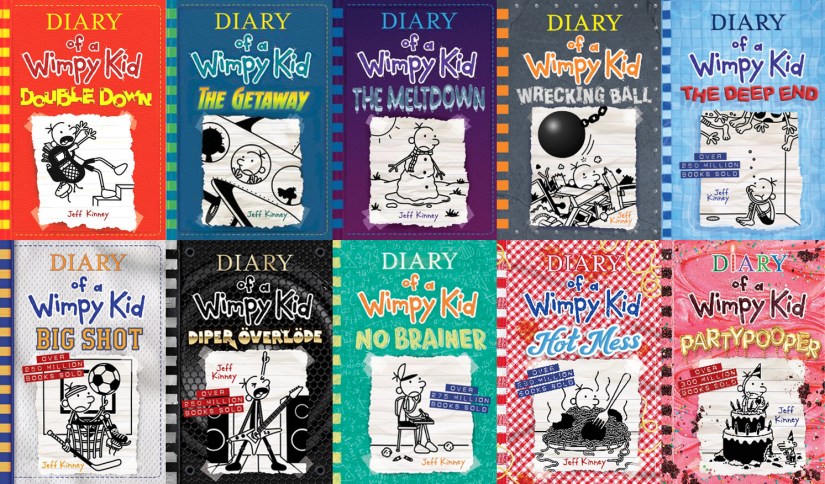
As you may know by now, the 20th Diary of a Wimpy Kid book, Partypooper, has been released. And I’ve been way behind on the series, partly due to finally growing out of the books in a sense, but also because of my commitment to personal projects. So, I figured that to commemorate the momentous occasion of the series reaching the 20-book milestone, and in response to the apparent demand, I’ve decided to make a second part to my post ranking the first ten books from worst to best by ranking the next ten books in the series from worst to best.
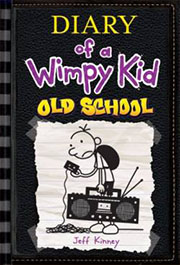
Now, I know what you might be thinking. Why? It’s no secret that the series has declined in quality since Old School, feeling more like a spin-off of the first ten books instead of an actual continuation. Because of that, ranking the next ten books wouldn’t be as interesting compared to ranking the first ten, right? But personally, I’m interested in seeing how all the mediocrity stacks up with one another. The books might not be as good as they used to be, but is each succeeding book really worse than the previous? Are there diamonds in the rough that is modern Diary of a Wimpy Kid, even if those diamonds are a bit rough themselves?
Not that I’m endorsing the mediocrity either, of course. I know that I declared a Diary of a Wimpy Revival with the launch of the animated film series and Poptropica’s explanation for Jeff Kinney’s absence back in February 2021. But nowadays, I wouldn’t call it a revival or a fall, just…a really odd in-between. Depressingly, in October 2024, the company that made Poptropica shut down. Luckily, it was moved to Cool Math Games, and although the new owners claim to be committed to the game’s future development, they haven’t yet updated the game since they acquired it. In the Poptropica Help Blog’s post announcing the shutdown, I made a comment asking why Jeff Kinney couldn’t have just kept funding the game before all this happened. Hot Mess was still coming out later that month. I also stated that I’m not even asking Kinney to focus on Poptropica again, but he could probably pour a fraction of his earnings into the game, and it would barely affect his revenue.

Curiously, 2024 also marked the first year an animated Diary of a Wimpy Kid film was not released on Disney+ since Kinney started helping produce them in 2021. It made me wonder if it was a sign that Kinney might pivot back to Poptropica instead of helping produce a fourth movie. But as it turned out, an adaptation of The Last Straw had in fact been in development and had been stalled due to the 2023 Writers Guild of America and SAG-AFTRA strikes. The film has been confirmed for December, which is a positive development, of course, and it’s a film I’m nonetheless excited to watch. Kinney also announced plans to develop downtown Plainville (the location of his bookstore, An Unlikely Story) back in February 2024. That’s admittedly a way better use of his money than reinvesting it into Poptropica, but it also makes it even less likely he’d ever revisit the game.
As far as Poptropica is concerned, I’ve gotten some unexpected closure from a great commenter named Wimpy Fan a while back. They cited Kinney’s most recent comments on Poptropica in May 2024, in which they pointed out how Kinney speaks about Poptropica in the past, rather than in the present. Kinney’s phrasing makes them think Poptropica is more like a “legacy” to be preserved, rather than a game that will continue to receive updates. They go on to frame Kinney’s career in video game terms, noting that he finished the “main story” – fulfilling his dreams of becoming a cartoonist and author, taking part in the release of a successful movie trilogy, and founding and developing a fondly remembered children’s video game. Now, he has moved on to “side quests” that aren’t necessarily what he’ll be most remembered for, but are still worthy projects to him, such as contributing to his town, writing more books and producing the animated movies.

Ultimately, Wimpy Fan is not convinced that Kinney has anything to prove with regards to Poptropica, but does admit that from a fan’s point of view, it would be great if he could come back to the game someday. Admittedly, I used to be a lot more adamant about Kinney returning to Poptropica, directly or indirectly. But now I’ll take it or leave it regarding his potential return. It is worth noting that Poptropica is among the few virtual worlds that are still active when so many others actually did shut down completely, so it’s a relief that Kinney at the very least believes in the game’s preservation. As long as the game still exists, there is hope for it. And all Poptropica really needs is money and passion. Maybe someday, a fan with enough money will be willing to breathe life back into the game. And I’ll support anything else Kinney does as long as it’s good. The 20th book is another fitting place to end the series if Kinney wanted to end it, though I doubt it. So, here’s to the next ten books being better than the last ten, and maybe even just as good as the first ten. And of course, I’d like to give a heads up to some spoilers in the books before I begin.
Anyway, on with the wimp-tastic countdown of greatness okay-ness!
#10: Double Down

For me, it was a no-brainer which book would be in tenth place. As I previously stated, Double Down marked the start of the Diary of a Wimpy Fall. When a series starts recycling the cover colors of previous entries, you know that it has overstayed its welcome. Not to mention that this was the last book in the series before the abysmal Long Haul film adaptation, so make that of what you will. What’s even more upsetting is that Double Down had a great premise: Susan insists that Greg tries to broaden his horizons, and for once, he does and tries to make a movie. I thought I knew where it was headed, but wow, never have I read a book with more untapped potential than this one. Everything, and I mean everything, fell flat at the end.
The first problem is what comes of the Balloon Brigade. Greg isn’t too thrilled to meet Maddox Selsam, who built a whole Lego city out of his aspirations to be an engineer. He eventually has a fallout with Maddox, putting an end to a potential friendship which was going to be important later in the story. The second problem is the whole point of Mariana Mendoza’s Halloween party, which could’ve easily been the place that inspired Greg to make the movie given the idea Greg eventually came up with. The final problem is the entire production of the actual movie, which has many problems in and of itself. The first obvious one is that despite this event being the focus of the whole story, it happens very close towards the end of the book. The other major problem is the fallout with Maddox, whose Lego city could’ve helped Greg shoot the battle between the Mayor and the 500-foot King Night Crawler at the end of the movie by putting gummy worms within the city and then superimposing the shot. This would’ve made Greg have respect for Maddox and see the same meaning in being an engineer as he saw in being a filmmaker. But even if Greg stayed friends with Maddox, Greg gets nowhere near this part in the production.
Basically, Greg never makes a movie, and he learns nothing from actually trying to learn something from his mother. At least the callback to the Cheese Touch was fitting, given the cover color recycling back to the iconic original installment. But plot wise, the book is just a disaster. To make sense of the book’s quality, I decided to find statements Kinney made about it. And I found these fascinating comments when he first revealed the book’s cover:
Greg Heffley has always believed there was something that set him apart from everyone else. In the new book, Greg discovers what makes him unique, and it’s not at all what he expected. After the 10th book, I found myself at a crossroads in my career. I wasn’t sure if I should continue writing Diary of a Wimpy Kid books or go down a different path. Double Down is really special to me, because it reflects a renewed commitment to the series and a plan for the future.
A different path, huh? Maybe a path back to Poptropica, perhaps?!? Oh, what could have been! But since Kinney went down the other path, Double Down had me fearful for the future, at least until The Getaway gave me hope. And let’s just say that I’m VERY relieved that Double Down stayed in its spot on the list, which has to mean something.
#9: Diper Overlode

And so, we get to the “unrealistic” covers, which reference the plot rather than actually look like the diary journal covers that made the covers appealing in the first place. I’ll be ranking these separately according to how realistic the material represented in the pattern would be if it were used to make an actual book cover. And the speaker pattern on the cover of Diper Overlode is the third least realistic. I mean, how do you make a book out of a speaker, anyway?
As for the book itself, it isn’t that much better either, being a massive downgrade from Rodrick Rules. Basically, Greg gets himself involved in Loded Diper’s antics, except he doesn’t really get involved in Loded Diper’s antics. The first thing I noticed is that Greg spends much of the story narrating what Loded Diper is doing rather than how he interacts with the band, even straight up admitting this at one point. Apparently, he plans to publish a book detailing Loded Diper’s dirty secrets when the band gets famous, which perhaps justifies why he does this. But in doing so, Greg writes Diper Overlode in such a way that Rodrick could have written it from his perspective (think what Rowley did with Awesome Friendly Kid) and it wouldn’t have made a difference.
While it’s nice to see how willing Greg is to tag along with his older brother (for the most part) after the character development they had in Rodrick Rules, Diper Overlode was the perfect opportunity to show how much their relationship had improved through the interactions they have with one another in ways that other books in the series didn’t have an opportunity to do. This does happen as the book gets closer to the end in some scenes, but it was hardly enough. What is here is at least amusing. The feud between Rodrick and Bill reminded me a lot of the feud between Greg and Rowley in the first book, with Rodrick playing the narcissist obsessed with being famous who doesn’t get his way, and Bill becoming the unlikely success story (even if it was brief) who even found a girlfriend (even if Rodrick almost ruined it for him). And one of the songs from the animated Rodrick Rules film is used in the book, which was kind of neat considering that the book came out before the movie!
#8: Big Shot

I consider the jersey pattern on the cover of Big Shot to be the second most realistic of the unrealistic covers. Fabric book jackets exist, although ones made from jersey are probably not too common if they exist at all. And it’s cool to finally have a white cover in the main series (after The Wimpy Kid Movie Diary), even if it’s technically because the jersey is white and not because of the diary journal itself. As far as the book itself, it’s a relief to have a full middle school plot again after The Deep End and the few scenes we got in Wrecking Ball and The Meltdown. The quality of that plot though is a mixed bag. Big Shot is another book that focuses on the relationship between Greg and Susan, although instead of her simply forcing Greg to spend time outside like in Dog Days, Old School and The Meltdown, she forces Greg to get into sports before he chooses to play basketball. While it’s hilarious to see Greg’s constant resistance to playing sports and practically embracing how bad he is at it, the book hardly explores this tension between him and Susan, a pattern I can’t help but to begin sensing here.
While wanting your child to be good at a sport isn’t by itself bad, it’s clear that Susan only wants Greg to play so she can relive her own days as a basketball player through Greg, even hoping he’d be better at basketball than she was, rather than understanding what he wants. At least Greg’s efforts to make Susan proud (however weak) were a little endearing, as well as the effort the other wimps on Greg’s team made to win a match against the cooler kids, which echoed a little bit of The Meltdown. But I have…thoughts about that twist at the end. Susan deciding to put Greg on the opposing team because she finally accepted that he wasn’t good at basketball is cynical at best and cruel at worst. And while Greg helping the opposing team win due to pure luck may have been comeuppance for Susan, Greg made the shot not because he wanted to stick it to her, but because he’s had it with the game, a just as cynical perspective on his part, at least until he wins the game. The ending isn’t terrible, it’s just very flawed, and while I can see what Kinney was trying to do here by punishing Susan, it was not the direction I expected the book to go. Perhaps if Greg actually stayed on his team and they won instead, and especially if Greg and Susan did a better job communicating to each other, the book could’ve been so much better.
#7: No Brainer
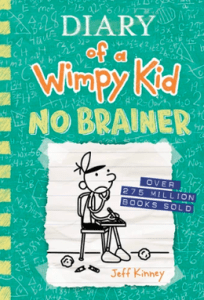
I consider the chalkboard pattern on the cover of No Brainer to be the third most realistic of the unrealistic covers. Although no book cover is probably being made with chalkboard, you can at least see that being somewhat plausible. As for the book itself, it’s a very mixed bag. The book not only has a much bigger middle school plot than even Big Shot, but it also has the best premise of the post-Old School books as well. Basically, the school is so poorly funded, and the students are performing so badly that the town threatens to close it down, and Greg and Rowley are forced to go to different schools if they don’t do good on their tests. Unfortunately, I was very disappointed to find that the book takes forever to get to this premise. FAR too much of it is spent on Greg explaining how bad things have gotten in the school and their efforts to improve the situation, and while some of it was good (the reference to book bans was great), other things actually really annoyed me. I know the films are a different continuity, but why does the school have a different name in the books? And the name has a relatively big role in the story, too. (And I’m not convinced that “Mr. Gupta” is actually Chirag Gupta’s father here, especially considering Chirag himself doesn’t appear.)
Things don’t actually happen to Greg (at least not anything that matters) until the PTA auction scene, and the threat to close the school doesn’t occur until close to the end. Which is a shame, because what happens from then on is actually really good! The school actually closes down, and Greg ends up in a worse school while Rowley ends up in a better one. There are actual stakes here, and a shocking twist involving the first girl Greg successfully dated in the series (outside of Holly Hills in the movies). Though I agree she should have been better designed, especially since The Wimpy Kid Movie Diary confirmed that Greg draws people according to his biases and not how they actually look, which made that design choice weird. And the way things return to the status quo was actually really clever! If Kinney had moved all of this close to the beginning of the book, this one would have been way higher on the list. Also, Freddie Larkin should have been Angie Steadman. Change my mind.
#6: Hot Mess
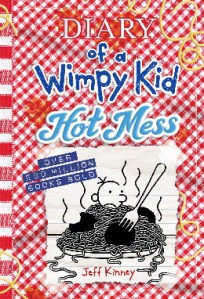
This is pretty much the point in the list when these books stop being inherently problematic for me. I consider the picnic cloth pattern on the cover of Hot Mess to be the most realistic of the unrealistic covers. The same fabric they use to make picnic cloth could absolutely be used to make a fabric book jacket, although the spaghetti probably wouldn’t stay on the cover, nor would Greg be likely to keep it a, well, hot mess. As for the book itself, it’s getting really tiresome at this point to see Greg going on yet another vacation after The Deep End. And if you ask me, Hot Mess is kind of a downgrade from the other “vacation” books, except maybe The Long Haul. The premise is arguably the weakest of the post-Old School books: Greg’s extended family goes on vacation to a beach house to honor his grandmother’s seventy-fifth birthday wishes. The book also teases Greg uncovering his family’s secrets, particularly the secret behind his grandmother’s prized meatballs.
Unlike The Long Haul, The Getaway and The Deep End, there aren’t as many unfortunate events happening to the Heffleys this time around. The few that do happen at least keep the book from getting too slow. Greg doesn’t spend too much time trying to uncover secrets, though it was cool to get the story of how Frank and Susan met. Though Susan is somehow even worse in this one than she is in Big Shot. You’re telling me that Gramma is the antagonist here? Gramma’s role in the book only becomes apparent by the very end, though at least by then, you start to wonder if she’s the reason for Susan’s behavior. Unlike in The Getaway and The Deep End, Kinney gives none of the Heffleys another chance to turn things around towards the end, except for Greg, who actually scores a pretty good deal with his grandmother that only Heffleys could make in their typical cynical way. It’s probably not a good lesson to learn, but it’s a resolution, nonetheless. Too bad we get yet another book that takes place during the time school isn’t in session with Partypooper.
#5: The Getaway

For The Getaway, I tried to stay under the mindset of seeing what not to do in a story, thinking that the rest of the series from here on in would be of the same quality as Double Down. Yet I was amused to find that The Getaway wasn’t as bad as I was expecting it to be. Sure, Greg is going on another vacation, thus making the book lack the relatable school humor that put Diary of a Wimpy Kid on the map. But for me, The Getaway dethrones The Long Haul as the best of the “vacation” books, at least until The Deep End.
The plot is pretty simple: Greg’s family decides to head south for a tropical vacation to escape the cold during the holiday season. But as usual, many unfortunate events happen to the Heffleys even before the vacation starts and continue until the vacation ultimately ends in the dumps. Admittedly, it’s quite an entertaining fall from grace to read, especially towards the end. Normally, the outcome of the vacation would’ve made the book just like the previous installment and bring back haunting memories of Dog Days, in which Kinney forgets to give Greg that one positive moment or two that makes the books worth reading towards the end. (By the way, I have been enlightened about what it is about Dog Days that works, and now I consider that book to be a bit better. In my list of the first ten books, I might now place it in between The Long Haul and The Third Wheel. And while Greg and Frank bonding over a comic strip technically counts as a positive moment, I’m talking something even more positive than that.)
But Kinney appears to realize what went wrong with Double Down and saves quite a few pages to give the Heffleys another chance to turn things around for the reader. This is where the book shines, offering an unpredictable turn of events that don’t disappoint. There is a pretty pessimistic, if somewhat relatable message that you can’t have a good time just because you have a family, and there is a revelation involving a side of the resort that is arguably inappropriate for children’s fare. But the book calmed down my fears for the future of the series, and it’s been a relief to get books that have been even better than it. (Good thing we never got that live-action sequel adaptation to The Getaway that was teased at the end of the Long Haul film, though.)
#4: The Deep End

I consider the pool pattern on the cover of The Deep End to be the least realistic of the unrealistic covers. The lack of tape on the illustration because of the water is a cool little detail, and it’s aesthetically pleasing, I’ll give it that. But how does this actually work? Fusing a pool and a book together via reality warping? As for the book itself, yeah, it’s a shame to see Greg going on yet another vacation, completely lacking the already scant school humor we got in Wrecking Ball. But for me, I have to admit that The Deep End dethrones The Getaway as the best of the “vacation” books.
Rather than heading south for a tropical vacation, the Heffleys decide to go on a cross-country camping trip. I actually really like how it begins where Wrecking Ball left off, and the plot goes into motion even faster than its predecessor, and just as fast as The Getaway. In fact, The Deep End is very similar to The Getaway, which probably isn’t a good thing. Both books essentially feature the same unfortunate events happening to the Heffleys during their vacation. But what makes The Deep End work better for me is how when Kinney saves a few pages towards the end to give the Heffleys another chance to turn things around, they turn things around in an even better way than they did in The Getaway. It literally isn’t even close. Thematically, it’s almost like a reverse version of the message in The Getaway that you can’t have a good time just because you have a family. Sure, Manny pulls off a pretty unrealistic feat for it to happen, though I’d argue that it’s not as crazy as building a whole house (more on this shortly). And the callback Greg makes to Manny putting in puzzle pieces at least justifies the feat in terms of plot threads. Too bad we get yet another book that takes place during the time school isn’t in session with Hot Mess.
#3: Partypooper

I consider the birthday cake pattern on the cover of Partypooper to be the second least realistic of the unrealistic covers. I debated between this and The Deep End over which cover quite literally takes the cake, but I figured that you could at least smear cake all over a book, even if that’s pretty messy (though plausible within the story itself considering what happens towards the end). I’d even argue that the illustration on this one didn’t need tape, either. I also never expected the series to have a pink cover, but this is arguably the best way Kinney could have done it. As far as the book itself, some wondered if, considering that Greg is celebrating his birthday in this one, and that the 20th book is a good place to end the series or at least mark a significant turning point, that it would be a story about Greg finally growing up. Well, I doubted it, and it turned out I was right, as the premise is far simpler than that: Greg wants a rare trading card for his birthday party. That’s it.
That might not be the most exciting premise, but at least Greg has a clearer goal in this one than he did in, say, Hot Mess. It might be yet another book that takes place during the time school isn’t in session, but at least more eventful things happen than in Hot Mess, and some surprising things too pretty early on. While more things technically happen in The Getaway and The Deep End, there’s just enough twists and turns here to make this less linear story a little more interesting. I like how Susan at least makes an attempt to be more redeemable here, but I also love what happens to her at the same time, which feels like a punishment for her after her behavior in Hot Mess. It’s yet another plot in which things must return to the status quo, though Greg made a dumb decision towards the end with Manny for the book to get there. The book’s biggest strength, however, is its final twist, which is actually a pretty great one, and would be cool to reference in later books. But if this is the last book that takes place during the time school isn’t in session, I don’t think anyone would be complaining.
#2: Wrecking Ball
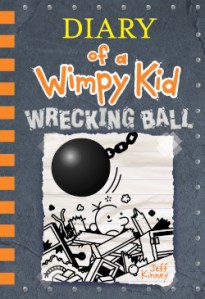
I consider the concrete and bolts pattern on the cover of Wrecking Ball to be the fourth most realistic of the unrealistic covers. Although no book cover is probably being made with concrete, you can at least see that being kind of plausible, even if that would be a pretty heavy book. As far as the book itself, it was, regrettably, a bit of a downgrade compared to The Meltdown, though not by too much. The yard sale scene in the beginning was pretty good, but after the inciting incident with Great Aunt Reba, the rest of the plot is okay at best. The idea of the Heffleys spending an inheritance on home improvement is a decent premise, though much of it is unfortunately consumed by more asides from Greg than usual, particularly his humorously naive explanations of what his own house will look like. There were some bright spots, however: the few middle school scenes the book had, primarily the test score subplot, was a nice break from all the construction. And the way Greg grappled with potentially losing Rowley as the Heffleys decided to move away was surprisingly good, even if there have been better stories between them. Had both of these things been expanded on instead of focusing on Greg’s fear of grout, the book could have been so much better.
Still, it was hilarious to watch the Heffleys quite literally screw up the renovations to their house. Unlike Double Down, you actually expect the characters to not achieve their goal here, and the book mostly understands that, with the odd exception of Manny. Typically, his unrealistic behavior is the point of the joke because its exaggerated, and he has pulled some pretty insane feats before. (In Wimpy Wonderland Island, he goes so far as hijacking a snowplow!) But it can be argued that him constructing an entire house is where we can stop suspending our disbelief. I personally thought the joke was hilarious, but I can see why some fans might have an issue with it.
#1: The Meltdown

I was kind of hoping that a later book would have taken the number one spot, but I guess you can’t have everything. Remember when I said in my post of the first ten Diary of a Wimpy Kid books from worst to best how much I liked the cover to The Meltdown? I think that gradients were a better direction to take the covers after running out of book cover colors rather than having them reference the plot, but oh well. As far as the book itself is concerned, I actually really liked it, being even better than The Getaway. The book begins with Greg’s perspective on climate change, which while funny, might be too on the nose for some and doesn’t propel the plot forward. But it’s all quite literally uphill from there, with a hilarious scene involving an assignment called the International Showcase that addresses the sorry state of international relations. Once again, Susan forces Greg to spend more time outside like in Dog Days and Old School, but there is more emphasis on Greg navigating the wintry battlefield that the book teases rather than addressing this tension between him and Susan. It might have made the book better, especially since it takes a while for the book to get to the snowstorm, let alone the battlefield. But Kinney still makes up for it by giving the book one of its biggest strengths on the way there: for once, there is actual continuity from previous books, and a lot of it as well!
The Safety Patrols were perhaps the most surprising, having not been referred to since the first book. There were even references to the Do-It-Yourself Book and Wimpy Wonderland Island, the latter especially being mind-blowing to me. (Too bad that wasn’t an indicator of anything though, as The Meltdown was published six years before the company that made Poptropica shut down.) These references, as well as the detailed descriptions of Greg’s neighbors, all culminated in an epic way towards the end. It was actually really awesome to see Greg and his fellow wimps quite literally get the high ground against the cooler kids in the way that they did, even if wasn’t for too long. And that fully illustrated spread at the end that we haven’t seen since? It perfectly captures the scale of the situation, and it’s easily the coolest drawing Kinney has made!
Well, that’s my personal opinion on the latter half of the Diary of a Wimpy Kid series. I will be posting modified versions of all these reviews (from The Meltdown onward) to my Goodreads shortly. Are you excited for the first direct film adaptation of The Last Straw? I know I am. While I could review the animated movie sequels, I won’t do it unless you’re curious enough to the point that you really want me to. But this is it for now, and who knows, I might make another book ranking post for another children’s book series in the future.
But for now, stay wimpy, folks. 😉

 Naimoli Children's Books Blog